Powered by Blogger.

Showdown in the South China Sea: How did we get here?


Dotted with small islands, reefs and shoals, the South China Sea is home to a messy territorial dispute that pits multiple countries against each other.
China's "nine-dash line" -- its claimed territorial waters that extend hundreds of miles to the south and east of its island province of Hainan -- abut its neighbors' claims and, in some cases, encroach upon them.
Tensions have ratcheted up as China has reclaimed some 2,000 acres of land in a massive dredging operation, turning sandbars into islands equipped with airfields, ports and lighthouses.
On Tuesday, China said it warned and tracked the U.S.S. Lassen, a destroyer, as it came close tofive of its artificial islands in the South China Sea's contested waters.
Cui Tiankai, Chinese ambassador to the United States, told CNN Tuesday that the U.S. patrol was "a very serious provocation, politically and militarily."

    Who claims what?

    Brunei, Malaysia, the Philippines, Taiwan and Vietnam all dispute sovereignty of several island chains and nearby waters in the South China Sea -- with rival claims to the Chinese interpretation.
    To the north, in the East China Sea, China is also locked in territorial disputes with Japan and South Korea.
    China is actually relatively late to the party when it comes to occupying territory in the Spratlys, which Beijing calls the Nansha islands.
    Taiwan first occupied an island in the archipelago after World War II, and the Philippines, Vietnam and Malaysia followed suit, and all have built outposts and airstrips on their claimed territory, according to Mira Rapp-Hooper, a Senior Fellow in Asia-Pacific Security Program at the Center for a New American Security (CNAS).
    The Philippines, which lies geographically closest to the Spratlys, has troops stationed in the area.
    China started its occupation of reefs and islands in the area in the late 1980s.
    Vietnam also disputes China's administration of the Paracel islands -- and last year saw tensions surge as its northern neighbor installed exploratory oil rigs in the region.

    What's China been building?

    Satellite imagery from 30 March, 7 August 2014 and 30 January 2015 shows the extent of Chinese progress in building an island at Gaven Reefs in the Spratly Islands.
    In 2014, China began massive dredging operations centering on three main reefs in the Spratly Islands -- Fiery Cross, Subi and Mischief Reef.
    It has reclaimed 2,000 acres in less than two years -- more than eight square kilometers, or around 90 football fields.
    In September, during his trip to Washington, President Xi Jinping said China wouldn't "militarize" the islands but is building three airstrips that analysts believe will be able to accommodate bombers, according to satellite images analyzed by the Washington-based Center for Strategic and International Studies (CSIS).
    In June, China's foreign ministry said it would soon complete the controversial land reclamation.
    However, it also added that it planned to build facilities on the artificial islands it has created and these would perform several tasks -- including military defense.

    How has the U.S. responded?

    The U.S. government takes no position on the territorial disputes in the South China Sea but it has called for an immediate end to land reclamation.
    It also sails and flies its assets in the vicinity of the reclaimed islands, citing international law and freedom of movement.
    In May, it flew over the islands, triggering repeated warnings from the Chinese navy and on Tuesday raised the stakes by sending the Lassen to within 12 nautical miles of the reclamations.
    Chinese military confronts U.S. spy plane
    Chinese military confronts U.S. spy plane 06:20
    "We will fly, sail and operate anywhere in the world that international law allows," a U.S. defense official told CNN following the latest U.S. sortie into the disputed zone.
    "U.S. Freedom of Navigation operations are global in scope and executed against a wide range of excessive maritime claims, irrespective of the coastal state advancing the excessive claim," the official added.
    And while it is currently China that is protesting the U.S. Navy's maneuvers, according to Gregory Poling, director of the Asia Maritime Transparency Initiative at the Washington-based Center for Strategic and International Studies, the U.S. has used these operations to contest claims made by nearly all the countries surrounding the South China Sea, meaning not just China but also the Philippines -- a treaty ally -- as well as Indonesia, Malaysia and Vietnam.

    What does international law say?

    According to Poling, international maritime law doesn't accord 12 nautical miles of "territorial waters" to artificial islands -- only natural features visible at high tide.
    This was the principle being tested by the U.S. Navy when it went within 12 miles of Subi Reef on Tuesday. It called the patrol a "Freedom of Navigation" operation.
    Before China's recent land reclamation, both Subi and Mischief reefs were submerged at high tide, while a sandbar was visible at high tide at Fiery Cross Reef, which could make its legal status more ambiguous, he added.
    Poling said under maritime law, artificial islands were not usually afforded the 12-mile territorial zone and that the U.S. Navy deliberately chose to send the destroyer near Subi Reef for this reason.

    What's at stake here?

    The area is potentially rich in natural resources and some areas, particularly around the Malaysian coast and off Vietnam have proven oil and gas fields with billions of barrels of oil and equivalent.
    While unexplored, much of the disputed area around the Spratlys is believed to be potentially rich in oil and other natural resources,
    It's also about China's position within the region and globally, maintaining control over islands that it claims is its "indisputable sovereign territories," as Chinese officials say.
    The current posturing in the area has led to heightened tensions between the world's preeminent military powers, and in May Former CIA Deputy Director Michael Morell told CNN that the confrontation indicates there is "absolutely" a risk of the U.S. and China going to war sometime in the future.

    Paul Ryan Wants to Shut Down the Government, Permanently

    Everyone has seen the news stories about how Representative Paul Ryan, the likely next Speaker of the House, is a budget wonk. That should make us feel good, since we would all like to think a person in this position understands the ins and outs of the federal budget. But instead of telling us about how much Ryan knows about the budget (an issue on which reporters actually don't have insight), how about telling us what Ryan actually says about the budget?
    Unless reporters give Ryan a pop quiz, they really don't know what he knows about the budget, but they do know what he says. And, he has said a lot on the budget and much of it is very clear. In addition to wanting to privatize both Social Security and Medicare, Ryan has indicated that he essentially wants to shut down the federal government in the sense of taking away all of the money for the non-military portion of the budget.
    This is a fact that is easy to find for any reporter who could take a few minutes away from telling us what a great budget wonk the next speaker is. In 2011, when he chaired the House Budget Committee, Ryan directed the Congressional Budget Office to score his budget plans. The score of his plan showed the non-Social Security, non-Medicare portion of the federal budget shrinking to 3.5 percent of GDP by 2050 (page 16).
    This number is roughly equal to current spending on the military. Ryan has indicated that he does not want to see the military budget cut to any substantial degree. That leaves no money for the Food and Drug Administration, the National Institutes of Health, The Justice Department, infrastructure spending or anything else. Following Ryan's plan, in 35 years we would have nothing left over after paying for the military.
    Just to be clear, this was not some offhanded gaffe where Ryan might have misspoke. He supervised the CBO analysis. CBO doesn't write down numbers in a dark corner and then throw them up on their website to embarrass powerful members of Congress. As the document makes clear, they consulted with Ryan in writing the analysis to make sure that they were accurately capturing his program.
    So what percent of people in this country know that the next Speaker of the House would like to permanently shut down most of the government? What percent even of elite, educated, policy types even know this fact? My guess is almost no one; we just know he is a policy wonk.
    The media's obsession with telling us that Ryan is a wonk, coupled with an aversion to telling us anything about where his wonkism takes him, is unfortunately the norm for political reporting. We get a very similar charade after every presidential debate.
    Like frustrated theater critics, the network commentators will invariably tell their audience which candidates were forceful or comfortable and which ones appeared nervous or unprepared. They almost never delve in the substance of the debate by explaining where candidates may have misrepresented facts or might be proposing policies with a proven track record of failure.
    This is 100-percent backward. Most people do not follow policy closely enough so that they could realize if a candidate asserted a fact about the budget or a foreign policy issue that was not true. The reporters covering the debate could provide useful information by correcting such incorrect statements and providing the necessary background. They could also highlight instances where candidates seemed to be promoting genuinely new programs or showing other policy insights.
    While competent reporters would have an advantage over most of the audience in policy matters, the commentators have no special expertise in determining which candidates looked forceful or nervous.
    The millions of people watching the debate are probably every bit as qualified as the network commentators in recognizing a nervous or confident person. We are all interacting with people all the time, and making judgments about their competence and sincerity. There is no reason to think a political commentator at NBC or NPR is any better at making such judgments than the people watching the debate on television.
    The budget wonkism of Chairman Ryan is a beautiful example of the failure of the national media to take their job seriously. Telling us he is a wonk, without telling us the content of his wonkism, is a bad joke which should get people very angry at the folks who pretend to give us the news.

    Billionaires Can't Teach Our Kids

    Last month, the Los Angeles Times released a terrifying confidential roadmap for privatizing L.A.'s schools that was produced by billionaire Eli Broad. Broad plans to raise and spend $490 million to create enough privately operated charter schools to house half of the city's public school students.
    The "Broad Plan" is an ambitious, all-sided assault on public schools, potentially funded by money from a who's who of the nation's billionaires, including the Walton heirs, Elon Musk and Steven Spielberg.
    Broad's strategy is to compete directly with the Los Angeles Unified School District (LAUSD) for what he calls "market share" by more than doubling the number of charters already in the city. Diane Ravitch writes that Broad wants to "decimate the remaining public schools by draining them of students and resources." Former LAUSD board president and state Assemblywoman Jackie Goldberg, calls it a plan to "privatize and destroy public education."
    Just imagine what these resources -- which are in the Broad Plan budget -- could do for L.A.'s existing public schools:
    • $21 million in what he's calling "civic engagement, and communications, grassroots organizing, and advocacy organization support"
    • $43 million on recruiting teachers
    • $280 million to build new schools
    • $135 million to grow existing charters and start new ones.
    To raise and spend that money, Broad has put notorious corporate 'reformer' Paul Pastorek in charge. Pastorek dismantled public education in New Orleans after Hurricane Katrina, and was a member of Jeb Bush's "Chiefs for Change," who pushed for high-stakes testing and privatization.
    Broad and his billionaire friends have decided that instead of investing in our public schools, they'll just create new ones with less accountability and fewer standards, and more control private control. They're doing the same thing in Louisiana, where Broad and two Arkansas billionaires have been dumping hundreds of thousands of dollarsinto school board races to push the school privatization agenda.
    If history is any guide, corporate 'reformers' have done more harm than good for students, teachers, and families. The Center for Media and Democracy (CMD) recently released figures on shuttered charter schools across the country--in Los Angeles alone, 37 schools have closed since 2000.
    I live in Los Angeles, and what the city's children need isn't help from billionaires. Every child needs a great school governed by the fundamental democratic principles of transparency, accountability, equal opportunity, and stewardship of public funds. We wrote our Charter School Accountability Agenda to further those principles.
    coalition of unions representing teachers, administrators, and school staff, along with community organizations like The Alliance to Reclaim Our Schools, and even some charter school advocates, are standing up against the Broad Plan. I stand with them. Billionaires can't teach our kids.

    Have Schools Forgotten Brain Science?

    Have Schools Forgotten Brain Science?

    2015-10-26-1445873080-1191377-Dissectingsheepbrains3.JPG
    Being an applied neuroscientist, I was stunned as I skimmed my daughter's 7th grade life science textbook and found that only 8 out of 400 pages discussed the nervous system. This amounted to one section of one chapter. In contrast, while genetics are certainly important, there were two complete chapters devoted to this topic.
    Then, I discovered that schools explicitly prohibit students from doing science projects that involve brain or behavior science. For such studies, a human studies board review and approval is required, so schools simply prohibit any studies involving people or animals. There is no field of science with more direct bearing on the effectiveness, productivity, and happiness of youth than neuroscience, yet students are being discouraged from exploring it.
    As schools jockey to assert their STEM (science, technology, engineering and math) credentials, youth are offered an array of programs focused on robotics, rockets, computer programming, and other topics. However, virtually no activities are available to youth that focus on neuroscience and related brain science, despite neuroscience being one of the most active fields of science today.
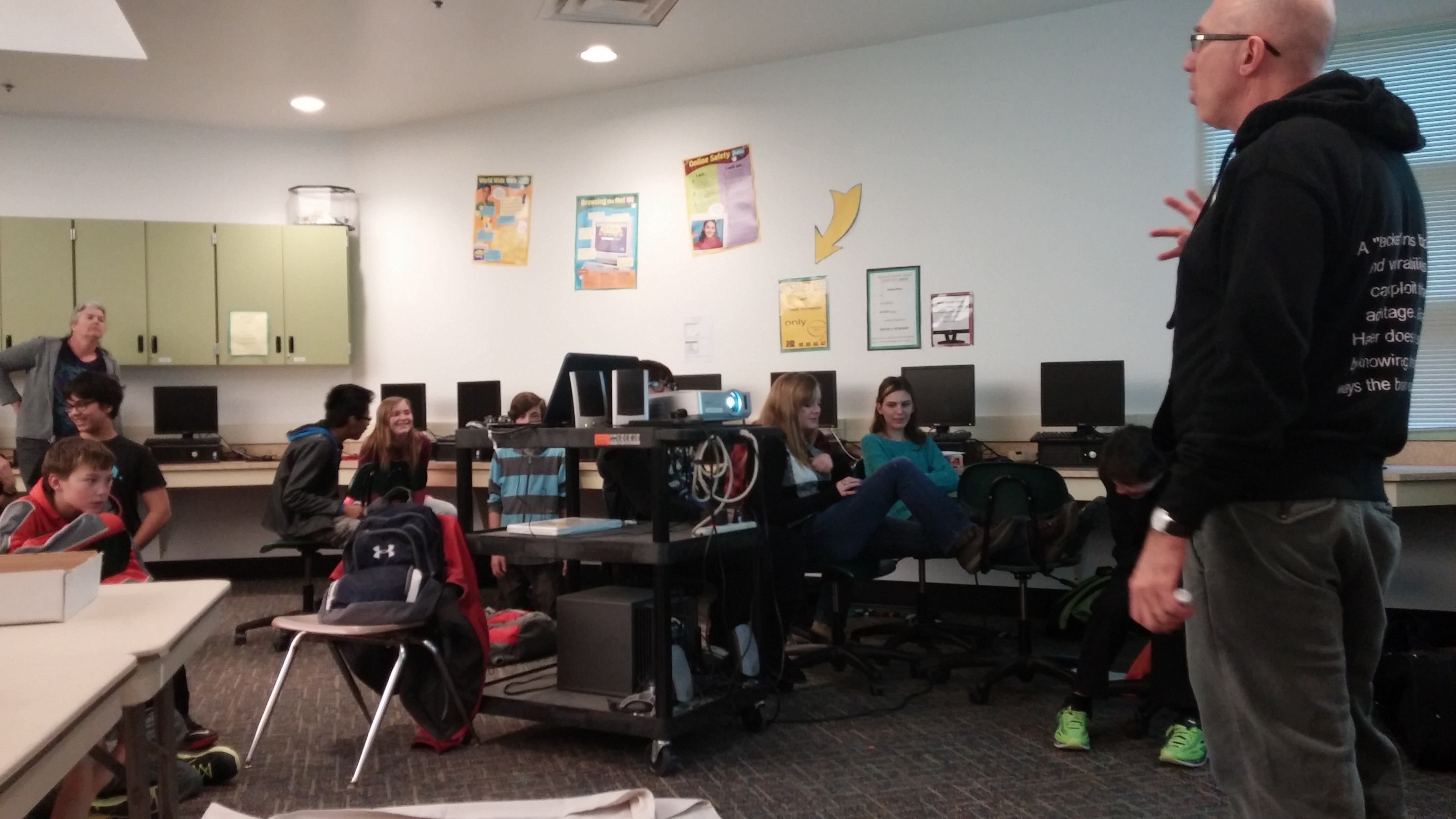
    To change this, I launched a program 2 years ago known as Brain Hackers. The program is being piloted as an after-school program for middle school students in Tijeras, New Mexico, near Albuquerque, and is poised to expand into other middle schools, as well as elementary and high schools, during the 2015-2016 school year.
    Based on the number of students in the program, Brain Hackers has been a hit. In each of the first two years of the pilot, more than 50 students have participated, which accounts for one-seventh of the school population. This is equivalent to the total number of students on the school's sports teams.
    I believe the program's popularity is rooted in making science relevant to the everyday experiences of youth. Brain Hackers presents pertinent topics from neuroscience, but makes them relatable, mixing brief 10-15 minute lectures with fun and engaging activities.
    In its first two years, Brain Hackers has covered an array topics. For example, a discussion of how the brain constructs 3-D representations of space led to a lesson in creating 3-D chalk sidewalk illusions. In another activity, student learned how the brain experiences music and then use an online tool for authoring music to create songs that conveyed different emotions.
    2015-10-26-1445873159-4014800-GroupPicSidewalkIllusion20144.JPG
    The most popular topic has undoubtedly been the module entitled "Girl Brain - Boy Brain." The module begins with a lecture concerning the physiological differences between the female and male brains. Then students participate in an activity in which six major neurohormones are each assigned a different color of sand and the students mix the different colors of sand in proportions equivalent to what is found in male and female brains. It has been almost a year and the kids are still talking about this activity.
    Students also learn to use EEG (electroencephalography) to observe and interpret their brain activity and create brain-controlled computer games and robots. It is incredible how with low-cost consumer grade EEGs such as the Emotiv Epoch and freely available middleware such as Puzzlebox, the students can construct brain-computer interfaces that are equivalent to what would have been dissertation projects only a few years ago.
    This school year is offering a completely new set of activities. With the assistance of local neuroscientist Russell Morton, the program will adapt Morton's "Brain of a Zombie" lecture to create a stage production that will be performed by the youth as a pre-Halloween school assembly, and for the community at a nearby community center. The book Do Zombies Dream of Undead Sheep by Timothy Verstynen and Bradley Voytek has provided the inspiration for this original play.
    Last spring, at the end of the school year, I asked the students what topics they would like to see the program cover, and several said, "Artificial Intelligence." Based on this request, an upcoming section will involve first learning about different brain functions and associated brain circuitry and then, attempting to model how the brain accomplishes the same functions using Lego Minstorm robots. The robots offer a unique opportunity to create a software program that emulates a function and then test it in the real world.
    2015-10-26-1445873191-2394814-BrainHackersMeeting.jpg
    For the past 7 years, I have conducted youth programs focused on robotics and repeatedly seen a pattern where kids start out enthusiastic in third and fourth grade, but by middle school, lose interest. This has been particularly true with the girls. By focusing on the relevance of science to everyday life, Brain Hackers has been successful in sustaining an interest in science through middle school. But notably, there has been an approximately 50-50 ratio of girls to boys, which is remarkable for a STEM program, especially given that the program is open to everyone and no special efforts are made to recruit and retain girls.
    Every Wednesday afternoon, I look at the room full of kids who have gathered for the weekly Brain Hackers Club meeting and remind myself that every one them could have been at home playing games or watching movies on YouTube, but instead, they have chosen to spend their time with me learning about neuroscience and how it relates to everyday life. Some may go on to become neuroscientists or bioengineers, or pursue some related profession, but I know that no matter what they chose to pursue in college and later in life, they will benefit from having a practical understanding of their brain and how it affects their everyday experiences in life.
    --
    Chris Forsythe is the President and Founder of the Brain Hackers Association and a Distinguished Member of the Technical Staff at Sandia National Laboratories. He has more than 25 years of experience in applied neuroscience, with an emphasis on improving human performance. He has led youth STEM programs, including championship robotics teams, for the past seven years.
    The Brain Hackers program is offered through the non-profit Brain Hackers Association. All of the resources created to date are freely available on its website. While still in its earliest stages, a primary goal of the program is to support others interested in starting up their own Brain Hackers programs within schools, museums, community centers and other organizations. While a background in brain or behavioral science is helpful, it certainly is not necessary.

    Let's All Take a Deep Breath About Pandemics

    Pandemics make for great drama. No TV or movie season is complete without at least one viral apocalypse--preferably involving zombies--sweeping the globe. But pandemics aren't just science fiction. They have happened--and perhaps will happen again. (For more, see "Breakthrough: Fighting Pandemics" November 1 at 9 p.m. (ET) on the National Geographic Channel.)
    So, quick quiz: what's the best way to motivate people to plan for the next pandemic?
    1. Be honest about the real risks, explain how these risks can be managed, demonstrate what is already being done and how successful it has been, and ask the public to support the necessary investment to maintain and extend that effort.
    2. Whip the public into a frenzy with scientifically implausible doomsday scenarios and imply that nothing is being done to prevent them.
    I guess you know where I'm going to come down on this.
    I take pandemics seriously; I spent nearly a decade studying the influenza virus that caused the granddaddy of all pandemics in 1918 and 1919. Estimates put the death toll between 20 and 50 million. The only other true pandemic--an outbreak of infectious disease that spreads rapidly across multiple continents or around the world--of the last century is still with us: HIV/AIDS has killed 39 million people since 1981, and nearly 37 million are living with the virus now, with just over one million people still dying every year.
    There have been other serious outbreaks of infectious disease: terrible as it was, the 2014 Ebola outbreak was confined to West Africa and contained in a matter of months. It killed fewer than 10,000 people. SARS spread around the world but was rapidly contained, infecting fewer than 10,000 people and killing fewer than 1,000. Other emerging diseases--West Nile Virus, Middle East Respiratory Syndrome (MERS), avian influenza--have not spread in humans widely or rapidly enough to rise to the level of pandemics.
    But is the risk of pandemics growing? Many aspects of the modern world raise concern. We know that live animal markets, increased reliance on "bush meat" for food, and the massive displacement that climate change will cause, will all provide opportunities for infectious organisms to move into new territories, and "jump" species boundaries. And of course air travel makes it possible for infectious diseases that once had to sustain outbreaks for weeks to make it from continent to continent can now do so in hours.

    On the other hand, advances in medicine, diagnostics, surveillance and communications put us in an ever stronger position to detect, contain, and treat emerging infectious diseases. In 1918, some 90% of deaths were caused by bacterial infections of lungs weakened by the virus. These deaths would now be preventable by antibiotics. (Nota bene, stopping the misuse of antibiotics and developing new ones needs to be right up there with pandemic prevention on the public health "to do" list.) It took 14 long years from the emergence of HIV/AIDS in 1982 to the development of the combination retroviral therapy that turned an invariably fatal disease into a chronic one. By contrast, SARS was first detected in November 2002, the coronavirus responsible was identified in March of 2003 and fully sequenced by April. The outbreak was contained by July.
    So the legitimate concerns are balanced by some considerable assets. And besides, let's not forget that viruses are not lurking behind every bush, just chomping at the bit to get into humans and wreak havoc around the world. As I wrote in two recent posts ("Viruses Are Not Omnipotent", Parts I and II), viruses don't jump between species willy-nilly. Viruses and hosts have evolved together for billions of years with the result that humans, along with every other cell-based life form, have elaborate and sophisticated immune systems to fend off viruses. Even though viruses tend to have high mutation rates (that's one of their evolutionarily-determined adaptations), it is not trivial to accumulate the multiple mutations that are usually necessary to thrive in a new host.
    Finally, lots of people are paying attention to the risk of a pandemic. Around the world, thousands of virologists, ecologists, epidemiologists, public health, aid, and disaster relief workers are collaborating to assess risk and plan for the worst. We know what we need to do: invest in basic virology and epidemiology research, build up health care capacity around the world, establish and maintain a comprehensive surveillance, diagnostics, and detection system, and make sure that public health authorities and emergency relief agencies around the world communicate with and trust each other, so that they're ready to share information and coordinate their activities quickly and effectively. Not very sexy, perhaps, but certainly more effective than hysteria.
    So let's all take a deep breath and put the risk of a devastating pandemic in perspective. Panic may grab people's attention for a little while, but it's not a sustainable basis of support for sensible policy. Hysteria leads to poor policy. Hysteria leads to uninfected health care workers being placed under house arrest. Hysteria leads to holding on runways airplanes that have been nowhere near the outbreak area to check on passengers with fevers. Hysteria leads to closing schools in Ohio and Texas for no good reason. Portraying the natural world as a seething hotbed of viruses poised to invade humanity, and implying that we are helpless in their path, is not just plain wrong--it's dangerously wrong.
    Zombie photo credit: By Bob Jagendorf via Wikimedia Commons
    Live animal market photo credit: "Chicken market in Xining, Qinghai province, China" by M M (Padmanaba01) via Commons

    The Prize: Who's in Charge of America's Schools?

    In 2010, Mark Zuckerberg, from Facebook, Chris Christie, then Governor of New Jersey and Corey Booker, who was the Mayor of Newark at that time, joined forces in an attempt to transform the failing Newark school system with the help of $100 million grant from Zuckerberg and his wife. At that time, fewer than 40 percent of third through eight graders in the Newark public schools were reading or doing math at grade level and almost half the students did not graduate high school. The system was obviously broken and needed to be drastically changed.
    In a compelling new book, The Prize: Who's in Charge of America's Schools, Dale Russakoff chronicles this ambitious and audacious plan, with its big failures and smaller victories.
    The trio of Zuckerberg, Christie, and Booker came in to try to flip this school system, predicting that within five years, they would have a national model for turning around any big urban school system that needed help. Russakoff wrote, "Their stated goal was not to repair education in Newark but to develop a model for saving it in all of urban America."
    Well, it has been five years and the results are in, the dramatic transformation did not take place, but some more modest improvements were made, primarily in the charter school sector of Newark.
    Things did not start off smoothly. The first big mistake was the way this project was announced. The teachers, students, and citizens of Newark heard about this project on the Oprah Winfrey Show, when the rest of the country first heard about the $100 million dollar donations. Newark residents thought they should have been notified about the proposal and also been included in formulating the plan.
    After he announced his $100 million donation to the cause, Zuckerberg said, "We are setting up a $100 million challenge grant so that Mayor Booker and Gov. Christie can have the flexibility that they need to implement new programs and turn Newark into a symbol of educational excellence for the whole nation." Thus, with the matching grant, they doubled their money. But more money did not ensure success.
    Another problematic area was in the renegotiation of teacher contracts. Zuckerberg wanted to be able to reward teachers who were doing a good job and get rid of the teachers who were not. Like some business leaders, he wanted to apply his "business" model to education. However, efficiency, taken as the "business" model, does not always address the complexities of educational reform.
    One of his big areas of concern was trying to get "bad" teachers out. Unfortunately, Zuckerberg was not aware that teacher's jobs were often protected by seniority laws in the state of New Jersey and the teacher's union was one of the most powerful lobbies in the legislature. When they went to reform the law, they were able to implement some of their new ideas, but that main issue, getting rid of "bad" teacher, could not be changed at all.
    Furthermore, out of the $100 million, a large portion of that was supposed to go directly to a substantial increase to teacher's salary. However, $20 million dollars went straight to high paid consultants, who were getting as much as $1,000 per day. One educator named these consultants, the "school failure industry." Contrast the consultant's pay with the Newark teachers, who eventually received a paltry $3,000 stipend added to their salaries that translated to about $10 per hour.
    On the other hand, the biggest success in this entire project was expanding charter schools in Newark who are performing at higher rates of achievement than the Newark city schools. Enrollment in charter schools, like the KIPP Academy, went from 20% to 40% by 2015. 
    In a compelling interview, Russakoff said the discrepancy with allocation of money going to students is due to waste in the Newark schools system that charter schools are able to avoid. Appropriately, Russakoff likened this to the difference between FedEx and the US Postal Service.
    Yet even with this modest success, there was a price to pay. With so many Newark students going to charter schools, enrollment went down for the other public schools and thus, the available funds also plummeted.
    And what has happened to Mark Zuckerberg's educational philanthropy? Did this sour his resolve to help schools? No, it appears he has learned a lesson and Zuckerberg currently works with local school in San Francisco Bay area. Now, he is including and working collaboratively with the educational communities in these improvement projects.
    With this collaboration, in high-poverty school in the Bay area, Zuckerberg is expanding the reach of his money, creating a "web of support for students," allocating some funds for mental health and medical support, realizing that school reform needs to take a broader approach, attempting to improve the entire lives of these families. It will be interesting to see the results of this new collaboration.

    New science award urges cancer research among high school students

    PBS LearningMedia, Stand Up To Cancer launch inagural Emperor Science Award to engage high school students in STEM research

    science-awardStand Up To Cancer (SU2C), a program of the Entertainment Industry Foundation, and PBS LearningMedia, a media-on-demand service designed for K-12 classrooms, announced the opening of applications for the inaugural year of The Emperor Science Award program.
    The Emperor Science Award program is an initiative designed to encourage high school students to explore careers in science, specifically cancer research and care, through a unique mentoring opportunity. The education initiative was first announced in spring 2015 by SU2C co-founder Katie Couric at Columbia University in connection with a new three-part film on the history of cancer that recently aired on PBS (it can be streamed online here).
    The program aims to empower high school students to become the next generation of cancer and health researchers and will award 100 students each year, for at least three years, with an opportunity to work alongside an esteemed scientist on a rewarding multi-week cancer research project.
    “The documentary Cancer: The Emperor of All Maladies was an incredibly powerful event and its impact continues through these science awards, which will encourage students today to explore the possibility of becoming the next generation of cancer researchers,” said SU2C Co-Founder Sherry Lansing who led the committee, which conceived and implemented this plan. “From the outset, it was an important goal for the documentary not only to inform, but also to engage and empower young people to pursue scientific careers, particularly in cancer research.”
    The program is open to students in the 10th and 11th grades living in the U.S. who have a strong scientific interest, especially in cancer research and care. Special emphasis will be focused on students from economically disadvantaged high schools.
    Entries to apply for the program will be accepted through November 1.
    In addition to the mentoring opportunity, students will also be awarded a Google Chrome Notebook to enhance their studies and to extend the reach of mentors to students living in rural and suburban communities, a $1,500 stipend for expenses, and the opportunity to continue the mentoring program, through high school, to further their academic pursuits. Students, including those who receive Emperor Science Awards, will be eligible to reapply in subsequent years.
    Students, teachers, guidance counselors and parents can visit The Emperor Science Award website (www.EmperorScienceAward.com) to learn more about the program and to apply. The webpage contains an overview of the program and associated resources for students. To enter, students will be asked to submit a 750 maximum word essay on the following topic:
    “Cancer has been referred to as The Emperor of All Maladies and millions of people around the world are looking for a cure. In America, more than 1600 people die each day. Tell us why scientific research is so important in helping to find a cure for cancer. And if you could be a scientific researcher, what would you study and why?”
    Essays will be judged on sincerity, creativity, clarity and persuasiveness.
    Winning students will be connected with science mentors from a host of high-profile medical research centers, including more than 100 SU2C-affiliated institutions, universities and industry leaders in cancer diagnosis and treatment.
    The Emperor Science Award Program has been made possible by generous support from Founding Donors Genentech, Bristol-Myers Squibb and Novartis. Their support will fund a total of 300 awards through the first three years.

    - Copyright © new life - Skyblue - Powered by Blogger - Designed by Johanes Djogan -